

What B2B Messaging Testing and Experimentation Still Can't Tell You
Every day is a messaging experiment you should be tracking. But you're not tracking the results beyond simple testing snapshots. What does it mean once you can continuously connect real-world, naturally occurring messaging and its variants to revenue outcomes?
I’ve done my share of messaging testing at B2B companies where I’ve worked or advised. It’s taken various forms depending on the situation.
Starting over a decade ago, my teams and I were excited to use tools like Optimizely to A/B test landing page variants on websites to see which drove more ebook signups. Or our marketing or CRM email automation tools to A/B test subject lines or other components of an email. Those situations and tools were focused on basic metrics: are we converting more volume? More clicks, more form submissions, more views.
I’ve used Wynter to A/B test the hero copy on Troupe’s home page. (Well, more accurately, we did an A/B/C test). We wanted to get focus group-like feedback on preferences to see which message resonated with our desired audiences. It only took a few days to get an answer, and we landed on something we still love. It was an easy, fast, and adequate tool to get a relevant sample’s gut-check on copy decisions.
The other situation where message testing comes up is more complicated, and before Troupe, I didn’t have a great solution to recommend. And that common scenario is: testing the true effectiveness of your overall go-to-market messaging narrative. And by effectiveness, we’re not talking about more clicks. It’s not about more visits, downloads, or demo requests. It’s about more revenue. Plain and simple.
With each new messaging creation or refresh initiative, at some point someone will ask: “How do we test this new narrative to know that it’s going to work for us?” The answer is usually to pitch it to a few ‘friendly’ customers or prospects and get their reaction to it. A small sampling, heavily biased. Directional but not real data. And certainly not followed all the way through to the revenue outcome, not with B2B sales cycles being as lengthy as they often are.
Another situation is messaging experimentation. You have the message you’ve already been communicating to the market, but now you want to test a variant of that in parallel. So you draft two versions, split traffic or sales reps, and run it for a few weeks to see what early signals you can collect from both qualitative and quantitative feedback.
These are all proven methods and should stay in your toolkit. They each answer a specific kind of question, but there's a much bigger and more business-critical one still to answer: how is your messaging influencing revenue outcomes once it’s actually out in the wild, across every rep, every deal, every channel, all your external content, all the time?
That's the layer most GTM teams are missing; not a replacement for constrained copy or messaging testing, but an ongoing view of live messaging performance measurement and attribution.
What Traditional Messaging Testing is Good at and Where it Hits the Wall
Messaging testing and messaging experimentation are controlled exercises. That's their strength and their limitation. To get a clean read, you have to hold variables steady:
- Time period — you run the test for a fixed window, so results only reflect what happened during that window, not what's happening now.
- Audience — you're usually testing against a defined segment or a subset of traffic/reps, which narrows how far the results generalize.
- Context, design, and delivery — the page layout, the ad creative, the email template, the rep's delivery, the prompt itself. Change any of those and you're no longer testing the message in isolation.
None of this is a flaw in methodology. It's the tradeoff that makes it rigorous. Controlling variables is what lets you say "B outperformed A" with confidence. But it doesn’t change the reality that the result is a point-in-time snapshot: this message, in this format, to this audience, during this window. It can’t tell you how that same message performs when it shows up unscripted in a discovery call, a follow-up email, a competitive objection response, or a renewal conversation and connecting all of that over the course of the sales lifecycle.
The Missing Layer: Live Messaging Performance and Attribution Monitoring
This is where Troupe fits, not as another form of snapshot-based messaging testing, but as ongoing monitoring of how your messaging is actually performing against revenue outcomes across everything that's really being said. You can think of it as messaging attribution. I do.
Troupe watches messaging as it naturally occurs: in sales calls, emails, decks, and content without constraining the time period, the audience, or the delivery context. It ingests those real interactions, analyzes what's actually being said against your intended messaging guide, and connects that to pipeline and outcome data: adoption, conversion, and win rate.
It finds variants of your messages and even ‘emerging’ messages from the field that aren’t in your messaging guide that everyone’s been trained and enabled on. This is commonly referred to as “rogue” or “off script” messaging. I did a blog post on this last year that acknowledged the virtues of rogue messaging as experimentation, but with the caveat that you must be are able to quantify its results. (By using something like Troupe.)
The messaging attribution result you get from Troupe isn't a single test result. It's continuous monitoring. You can filter by date range, deal type, team, or specific message. For example: Show me the results of New Business deals vs. Existing Customer upsells and renewals.
With Troupe for messaging performance attribution, you're observing patterns at scale, across a much larger and frankly messier sample than any single test could capture, and letting statistical significance emerge from real usage rather than from a designed split.
This is why live messaging performance monitoring can surface things a controlled test structurally can't: a message your reps rarely use that correlates with a meaningfully higher win rate when it does show up, or a message everyone leans on that's quietly associated with more losses. Those are "rogue" successes and hidden underperformers. Patterns in the wild, not results of a designed test.
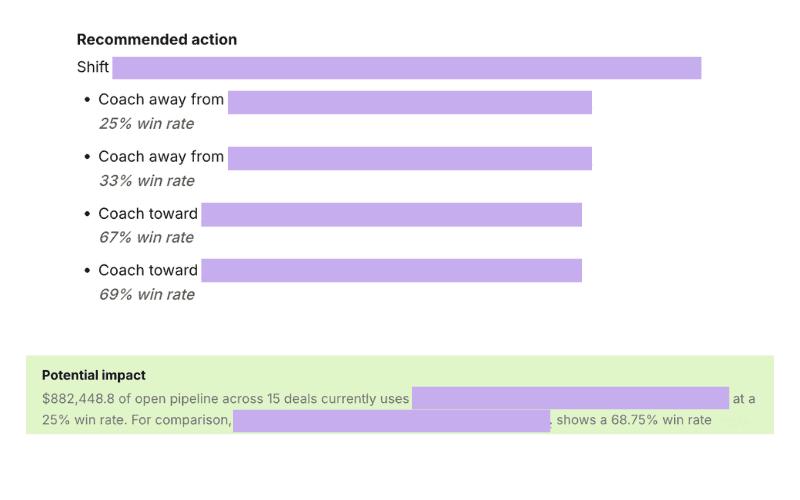
Here’s an example from a real customer, redacted to protect their identity. Troupe found that for one of their feature-level messages, sales was delivering four variants of it across both new and existing customers. Troupe was able to show which variants were under-performing and over-performing in terms of a blended win rate compared to the baseline win rate, which could then further be broken down by seeing performance in new, renewing, and expansion deal types.
But as you can see from the data, it’s clear that two of the variants were the better bet, and how much revenue was at stake: $900K in 15 open deals where the lower-performing variants were being used:
Adding in an Always-On Messaging Attribution Tracker
It's worth being direct about this: live messaging monitoring doesn't replace messaging testing or messaging experimentation, and it isn't trying to. Controlled testing is still the right tool when you need a causal, apples-to-apples comparison (a landing page headline, a subject line, a specific call-to-action) where isolating one variable is exactly the point.
Live monitoring answers a different question: how well is your full messaging system driving revenue as you look simultaneously and collectively across every real touchpoint? One tells you which message wins under specific, controlled conditions. The other tells you which messages are winning as a statistically substantiated pattern under all the conditions your GTM motion actually operates in.
For marketers, sales managers, sales enablement and customer success who are under pressure to show their messaging's connection to revenue, that distinction matters.
This was not an easy challenge to solve, but Troupe has done it through a robust combination of various AI techniques, including multiple LLMs, natural language processing, and machine learning. We have also built a system that has memory, scalability, consistency, and integration points.
Schedule a demo of Troupe to see it in action.