
Gartner Ramps-Up Focus on Product Marketing and Messaging Strategy: Troupe’s POV
Troupe advisor applauds Gartner's ramped-up research coverage of the product marketing role and its related ownership of messaging strategy.
Our team at Troupe talks to product marketers on the daily. All of them more or less “own” messaging. We also talk to CMOs and Revenue leadership who are direct stakeholders of a successful messaging strategy.
So we are excited that Gartner is increasingly investing research time in the area of product marketing management (PMM) and the messaging and storytelling jobs that fall under that domain.
First, some quick context-setting: For years, product marketing has been the function that nearly everyone agrees matters, few fully understand, and almost no one measures. PMM teams spearhead the positioning, build the narrative, formulate objection and competitive handling, and then arm content teams and sales with the story points to deliver.
Historically, that has meant watching the story drift or get left behind during calls, emails, demos, and decks with no clean way to trace it back to the original plan and to the pipeline.
That's all changing, and one of the clearest signals is coming from Gartner. Over the past year, Gartner's marketing analysts have poured research firepower into both product marketing and messaging, spanning both the tooling and the professional development required to keep up in our changing AI-infused go-to-market landscape. We insert our applause emoji here. 👏👏👏
Let’s look at some of their recent analyst activity (any reports linked are accessible only to Gartner clients)...
Product Marketing and its Enabling AI Tech Getting More Visibility
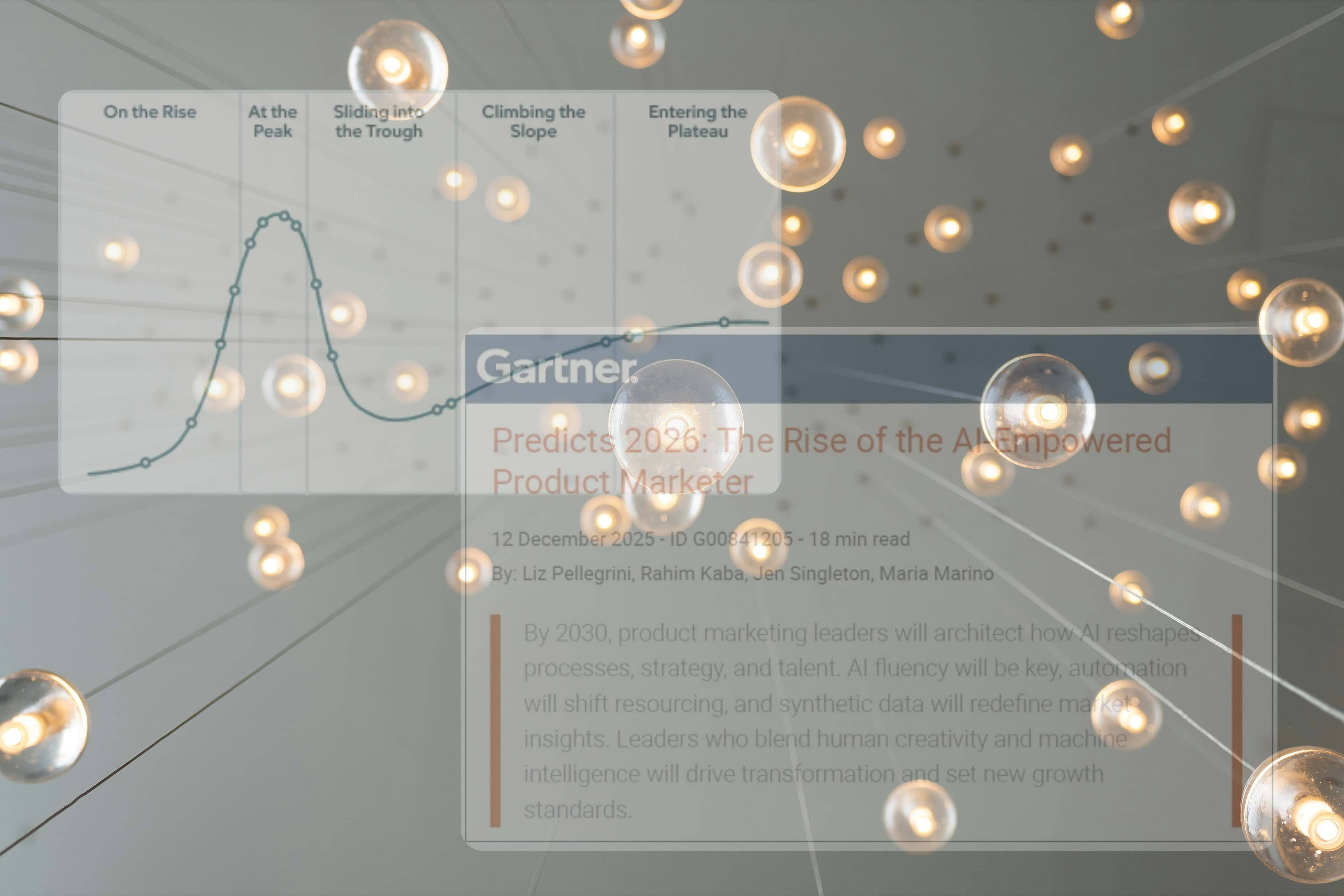
Gartner in June 2026 introduced its first-ever Hype Cycle for Product Marketing. One of the report’s authors, Ray Pun, Senior Director Analyst at Gartner covering marketing tech, called out a highlight from the report that resonated with what we’re doing here at Troupe: “Success now depends on turning diverse market signals into actions that drive revenue and retention: High-performing teams use AI and data to sense and respond to buyers, markets, and competitors in real time.”
The report also frames product marketing as evolving from a static, siloed function into what Pun and colleagues call "AI-enabled GTM orchestration," teams that sense market signals in real time and turn them into action, rather than executing a fixed playbook.
We’ve briefed Ray and several other Gartner analysts a few times in the past year, showing them how Troupe provides true measurement of what messages are working, where, and when – so that those signals can be used to improve pipeline performance.
And that theme of ‘product marketing as orchestrator’ runs through a second major piece of Gartner research that was also released in June 2026: An Insights-Driven Model for Product Marketing, led by Rahim Kaba, VP Analyst at Gartner, alongside co-authors Jennifer Kady, Brooke Grimes, and David Yockelson. Kaba has long argued that product marketing sits at the intersection of buyer truth, product reality, and sales execution. This report goes further, laying out a six-step decision framework for turning market signals into trusted direction, and mapping PMM accountability across four areas: product strategy, GTM strategy, GTM execution, and customer growth. Gartner clients can access the full report; a free webinar version is reportedly on the way for everyone else.
We argue at Troupe that you can’t show accountability without measurable data, and with nearly every GTM tactic resting on the power of your messaging elements, that’s crucial data to close the loop on impact.
An excellent companion piece for larger teams running more complex product portfolios is the Gartner Product Marketing Planning Framework, with the 2026 Edition published July 2026. This is a 28-slide toolkit built to help leaders run an adaptive, insights-driven PMM function rather than a purely tactical, reactive one. What's new in this year's version, per Kaba, is a shift away from static quarterly planning toward ongoing adaptation, with practical tools for retrospectives, prioritization, and even a PMM roadmap, plus guidance on aligning with product, demand gen, sales, and customer success.
Product Marketing and Story Measurement Has Analysts’ Attention
This is the part that hits closest to home for us. Gartner has been directly addressing the measurement gap that product marketing has struggled with for as long as the function has existed.
In Product Marketing Dashboards Must Convey GTM Impact (June 2025), analyst Ray Pun acknowledges that the ‘upstream’ work of defining the positioning and sharpening differentiation has been challenging to connect to the downstream pipeline and revenue metrics that leadership actually watches. That timing gap is a big part of why PMM's impact so often goes unrecognized by executives, even when the work is doing exactly what it's supposed to do. Pun's recommendation is for leaders to build dashboards and narratives that explicitly connect their team's work to win rates, product adoption, and pipeline health.
That’s exactly what Troupe is doing: Our approach in applying various AI/ML techniques allows us to connect the planned message to the actual execution and the outcomes – triangulating this loop so that PMMs and their Revenue and Marketing leadership have automated, trustworthy data that has never existed before.
Speaking of which: More recently (May 2026), Pun published research on Modernizing GTM Analytics to Help Product Marketing Win Executive Support‚ arguing that the traditional metrics teams have relied on are holding the function back, and that advanced analytics and attribution are what's needed to connect product marketing activity to revenue, pipeline, and adoption outcomes. Notably, alongside a group of GTM and analyst-relations experts Gartner tapped for input on that research was our own CEO, Austin Webb. We take it as a meaningful sign that the industry is converging on the same problem we built Troupe to solve.
Forecasting the Future of the PMM Role
Gartner's research direction also addresses what the function needs to look like as AI reshapes it. The report Predicts 2026: The Rise of the AI-Empowered Product Marketer, from Rahim Kaba alongside several co-authors, covers four ways AI is reshaping the discipline. It argues that AI fluency is the single most important skill investment PMM leaders can make in 2026, to the emerging and still-cautious use of synthetic customers in persona and messaging testing. (Troupe’s perspective would be that if you use AI to mimic buyer personas to test messaging, you must also do that alongside real-world messaging measurement of what’s happening with the personas receiving your messages now!)
We’re looking forward to hearing more about this in the Gartner webinar, Product Marketing's New Mandate in 2026, hosted by Rahim Kaba and Jen Kady on July 30, 2026. It's built around that idea of AI literacy being a core competency expected in product marketers, spanning data-driven experimentation, workflow design, and brand stewardship.
Why Troupe is Watching Gartner’s Coverage
Let’s be honest: Troupe doesn’t fall neatly into an existing category, so having an analyst firm like Gartner expanding their focus in this area and actively engaging with us demonstrates that there is a defined problem that calls for a solution like ours. Analyst research weight is clearly aimed at defining the strategic importance and opportunity for product marketing and messaging, as well as the tooling needed to make that measurable and successful.
It's genuinely encouraging to see Gartner's analysts arrive at the same conclusion from the research side that we've been building toward from the product side: messaging isn't a soft function. It's measurable, and it's revenue-critical.
by Jennifer Sikora, Troupe's founding advisor and fractional CMO