
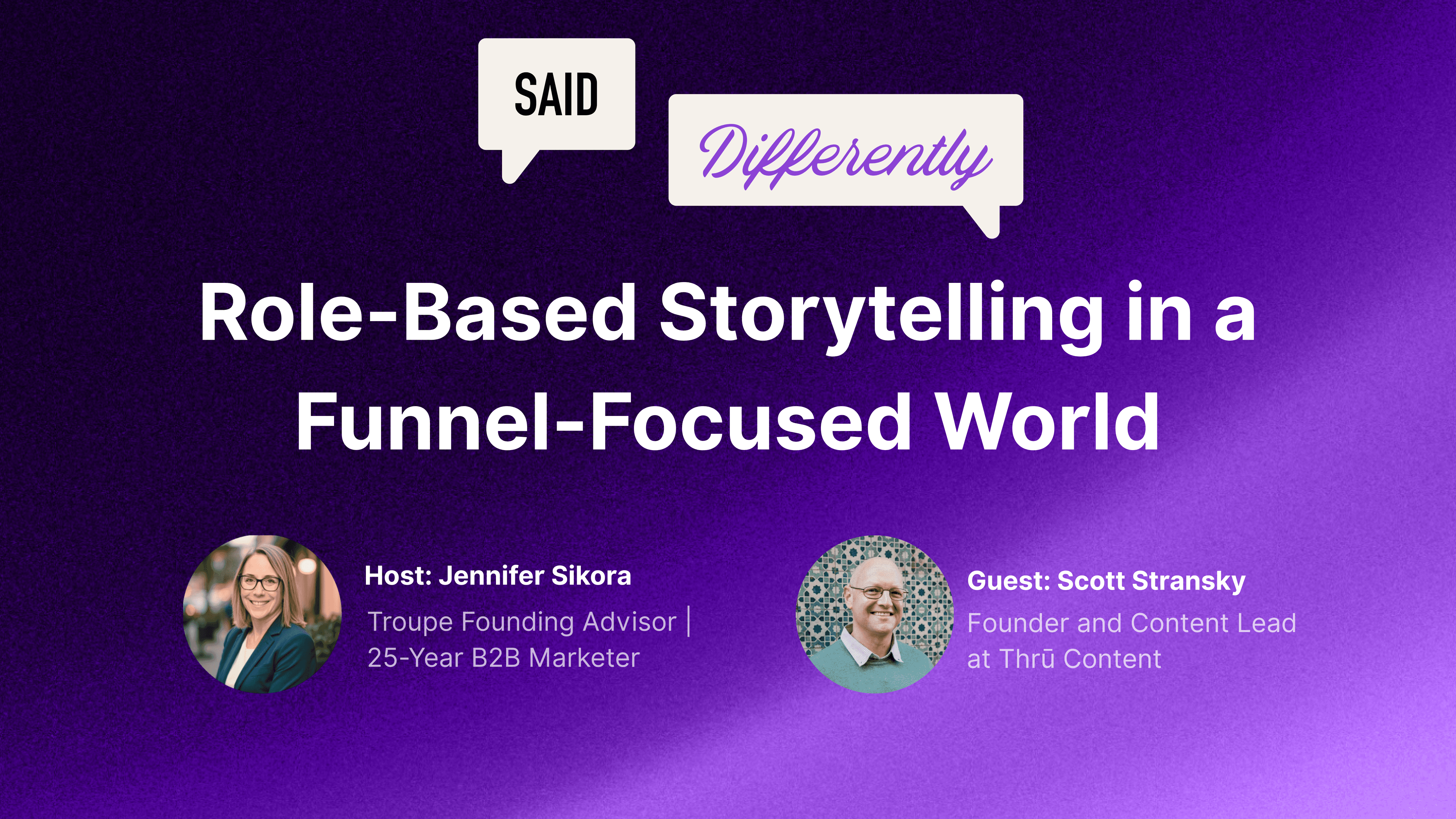
SAID DIFFERENTLY Ep.13: Role-Based Storytelling in a Funnel-Focused World
What happens when you apply a behavioral change model to content strategy? Scott Stransky, founder and content lead at Thrū Content, talks about messaging for roles and readiness in this recap of Troupe's Said Differently episode.
Rethinking B2B Content Through Buyer Readiness and Behavioral Change
In this episode recap of Said Differently, host Jennifer Sikora, advisor at Troupe, sits down with Scott Stransky, Founder and Content Lead at Thrū Content, to explore why his position is that traditional funnel-based marketing no longer reflects how B2B buyers actually make decisions — and what marketers should do instead.
Scott brings a behavioral lens to content strategy, challenging long-held assumptions about awareness stages, buyer intent, and the role content plays in moving deals forward. Together, Jennifer and Scott unpack why understanding buyer readiness — not just buyer roles — is becoming critical for modern B2B storytelling.
Why the Traditional Funnel Falls Short
As Jennifer sets up the conversation, she notes how deeply the idea of a linear sales funnel is embedded into how marketers operate — from CRM systems to forecasting models — even though real buying journeys are anything but linear.
Scott agrees, explaining that his own thinking has evolved significantly over the past few years. “The structure of awareness, consideration, action and advocacy, the conventional marketing funnel, just didn't really align with with how people actually act and react in a situation where they need to do something.”
Rather than viewing buying as a sequence of clicks or attributable actions, Scott frames it as something much more human. “The buyer journey is not a series of click actions and attributable actions, but rather a series of small behavioral changes made over the course of time.”
This change in the perspective of a buyer's journey may change how marketers think about content and how they measure its success.
Buyers Aren’t Unaware. They’re Unready.
One of the biggest assumptions Scott challenges is the idea of the problem-unaware buyer. Instead, he said most buyers already know the pain points. They’ve often even accepted inefficiencies as the “cost of doing business.”
As Jennifer adds: “They've lived them... they've developed work arounds and they've developed tolerance for it.”
Scott describes this state as being married to the status quo, not because things are working well, but because change itself feels risky. “I'm reluctant to change, because change sucks.”
This insight reframes the marketer’s job. The challenge isn’t introducing a new problem; it’s helping buyers become psychologically ready to consider change at all.
Applying Behavioral Change to B2B Buying
To better understand this dynamic, Scott draws from the transtheoretical model (TTM) of behavior change, a framework originally developed to help people overcome addiction. “When you understand what these stages of change are, you can draw a direct correlation to how people make decisions about buying things.”
In this model, the earliest stage is pre-contemplation — when someone isn’t even thinking about making a change. At this stage, buyers may rationalize existing systems, resist outside influence, or simply feel resigned.
Recognizing these psychological states allows marketers to create content that meets buyers where they actually are, rather than where the funnel says they should be.
Personalization at Scale for Buying Committees
Complicating matters further, B2B decisions are rarely made by one person, but as part of a buying group or a buying committee. Each member brings different motivations, risks, and biases — and each may be at a completely different stage of readiness.
Scott explains that Thrū Content’s philosophy centers on “role-based personalization at scale, done through a lens of psychological behavior, psychological readiness for behavior change.”
This approach combines who the buyer is with how ready they are to receive a message, a powerful combination for modern content strategy.
Measuring Content Without Guessing Intent
Measurement of what's working is often where things break down. Rather than relying on clicks or assumed intent, Scott recommends tagging content by behavioral stage. “You develop your content within these five or six stages of behavioral readiness… and you tag each asset in each stage.”
This allows marketers to observe content consumption density — seeing when buyers begin moving from one stage to the next — without prematurely forcing them into sales workflows. “The funnel doesn't allow for backward movement, whereas the stages of readiness does.”
Buyers can pause, regress, or re-evaluate — and content strategy should account for that reality.
Rethinking the Role of ROI Content
The conversation also touches on one of the most requested — and most misunderstood — content types: ROI. While Scott sees ROI as necessary, he cautions against overvaluing it. “I think ROI metrics are table stakes. I also don't think that they that they're really impactful for moving sales, for moving deals forward.”
In crowded markets, ROI numbers quickly become an arms race. “When one vendor comes out and says, ‘Hey, we delivered 37% ROI,’ the next vendor is going to come out and say, ‘Well, we did 41%.’”
Without behavioral context, he believes metrics alone rarely change minds.
Jennifer highlights how this behavioral approach aligns closely with how Troupe analyzes messaging across real buyer interactions — not just owned content. “We're looking at not just your content, but all your messaging.”
By identifying which messages consistently appear as deals progress, teams gain clearer signals about what truly influences movement — and where to invest next.

A More Human Way to Think About B2B Content
With many generative AI tools available to help, everyone can be a content generator. But more content faster doesn't mean that content is strategically aligned with a realistic buyer and decision-influencer journey.
At its core, the conversation between Jennifer and Scott is a reminder that purchase decisions are human decisions first. By considering behavioral readiness, marketers can meet potential buyers (and even existing customers) where they are and help move them to the next stage of psychological readiness.