

Three Elements Needed for Messaging Success Measurement
To know if your messaging is helping drive revenue, you need to measure it. There are three requirements that come together to measure messaging: intended messaging, actual messaging, and results.
One of the oldest — and shockingly still most enduring — questions in go-to-market is simple to ask, yet surprisingly hard to answer: Do we have the right messaging?
And by right, we don’t mean “does it sound good internally?” We mean: Is it actually working as best as it can to attract, engage, and convert the right buyers — efficiently and at scale?
When Messaging “Works”… But Still Fails
Most teams fall into one (or more) of these messaging realities:
- The messaging drives attention, but from the wrong buyers. Traffic, clicks, and initial curiosity goes up — but not from best-fit prospects. The result is wasted spend, wasted time, and misdirected effort.
- The messaging generates interest from the right targets, but conversions stall. Some good prospects raise their hand, but conversions after the early stages are less than hoped. You end up paying much more than necessary to drive and move potential buyers through the pipeline.
- The messaging performs well — but inconsistently. The messaging itself may be effective, but it isn’t widely adopted or applied consistently by the right people, to the right personas, at the right moments. Or you have “rogue” messaging being used by team members with good results, but you don’t know it. Overall impact and ROI suffer.
In every case, the same problem shows up underneath: We’re relying on opinions instead of evidence to judge and scale messaging effectiveness.
Measurement Attempts That Miss the Mark
Most teams want to be data-driven about messaging — but the data available to them is narrow and incomplete.
Traditional A/B tests or online panel feedback on landing pages or email content offer some signal, but they:
- Cover only a small slice of the buyer journey
- Ignore how messages show up in conversations, sales cycles, and follow-ups
- Miss the reality that today’s messaging lives across many channels, formats, and human interactions
Now, many are looking to tackle this challenge using AI to analyze large volumes of data and content. But often those efforts only take this challenge in parts and in episodic reviews, such as by looking for keyword-matching patterns in a batch of call transcripts or content items.
The result? Messaging decisions get made through episodic reviews, anecdotal feedback, or keyword-level analysis that lacks context.
What “Good” Measurement Actually Looks Like
The ideal state isn’t just knowing what performed better — it’s having confidence that your desired go-to-market story is improving outcomes across the entire funnel.
That means being able to:
- See before-and-after impact when messaging changes
- Understand how messages perform at different stages and with different personas
- Connect messaging adoption and usage to conversion, velocity, and pipeline health
The Three Elements Required to Measure Story Performance
At Troupe, we believe three elements must work together continuously to get a true, data-backed picture of messaging performance – and it’s how we’re approaching it through our AI solution. You might also consider this a “three-legged stool,” meaning if you’re missing one of these pieces, your assessment of messaging impact isn’t structurally sound.
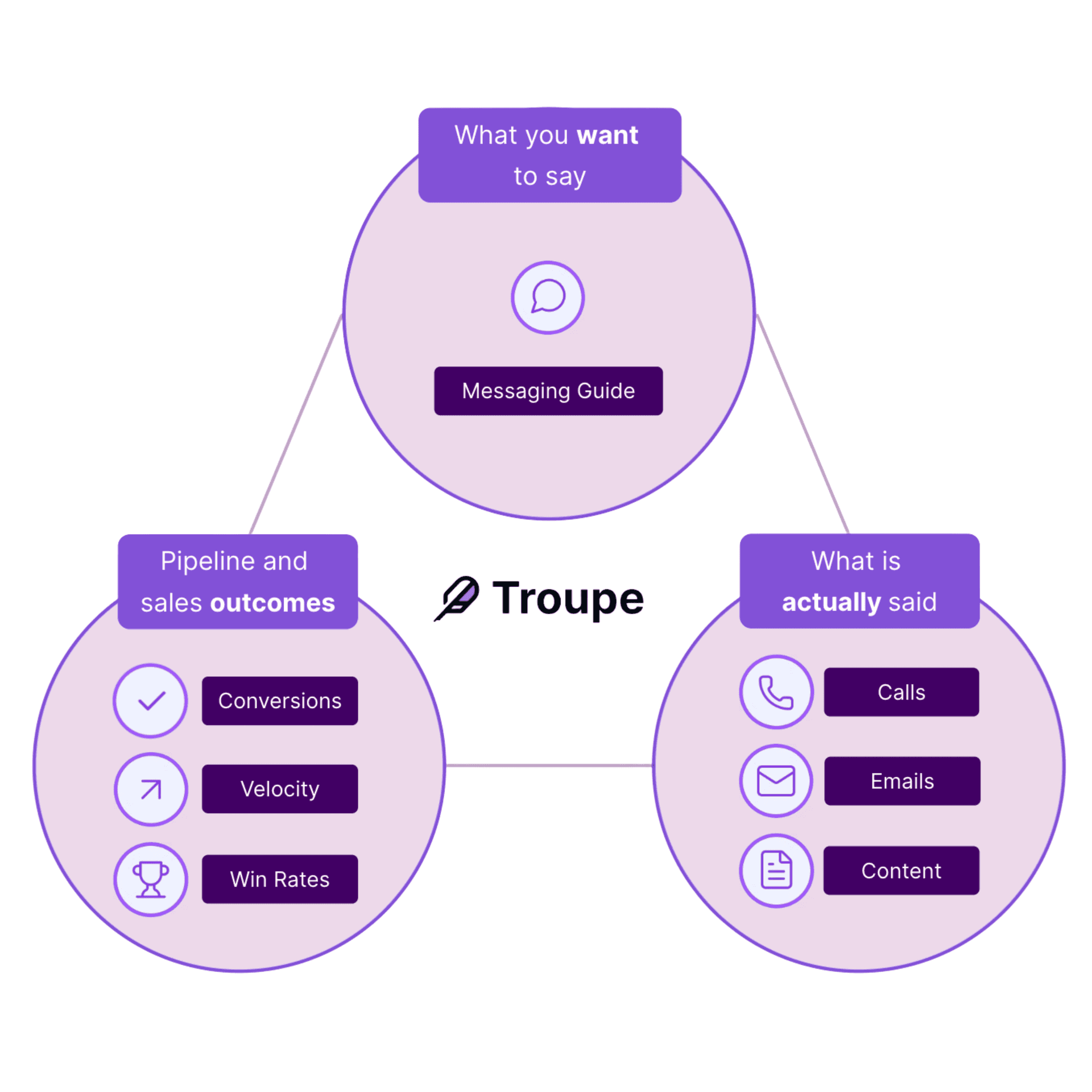
1. Your Intended Story
A lot of effort and collaboration can go into coming up with the messaging you believe you should be delivering to the market. Therefore, every analysis must start with that internally agreed-upon messaging guide: What do we want to say, to whom, and when? Analyzing conversations or content without this benchmark or comparison removes the most important reference point.
2. What’s Actually Being Conveyed
Enablement and training don’t guarantee consistency in the wild. Sales conversations are dynamic. Buying journeys are non-linear. And with AI, everyone is now a content creator. You need a way to see how real-world interactions and assets compare to the intended story.
3. How It Connects to Results
This is where messaging meets the business.For example:
- Which messages lift conversions at the top of the funnel — and for which personas?
- Which reps or teams outperform — and what are they doing differently from a messaging perspective?
- What should be scaled, refined, or retired?
From Story Alignment to Revenue Impact
When those three elements are connected, you can finally answer questions like:
- How aligned are we to the story we want to tell?
- How quickly is that story being adopted?
- Which messages improve conversions and win rates?
- What happens to pipeline and revenue when we roll out new messaging?
That insight changes everything. Messaging decisions become clearer. Training becomes more targeted. GTM investments deliver returns faster.
You will always be telling a story to the market — through every channel, conversation, and piece of content. The advantage is knowing, with data, how well that story is actually working.