
Video Tour: 3 Ways to Connect B2B Messaging to Revenue Outcomes
Watch a 3-minute demo of how Troupe ties B2B messaging to win rates and revenue in your pipeline, from strategic patterns down to individual deals.
B2B messaging should no longer be only "Marketing's concern." It should and can connect to revenue outcomes. Troupe is built to deliver that messaging intelligence and quantification. It analyzes how your messages and talk tracks actually show up in sales conversations, then connects that messaging to win rates, pipeline, closed revenue, and revenue at risk. That's board-level worthy data.
In our new three-minute demo, we walk through three features that show exactly where your messaging is making you more money, where it's leaking or introducing risk, and what to do about it.
Watch the demo (3 minutes)
(Turn your sound on: the demo is narrated. All company names, deals, and figures shown are sample data from a fictional company, NovaTech.)
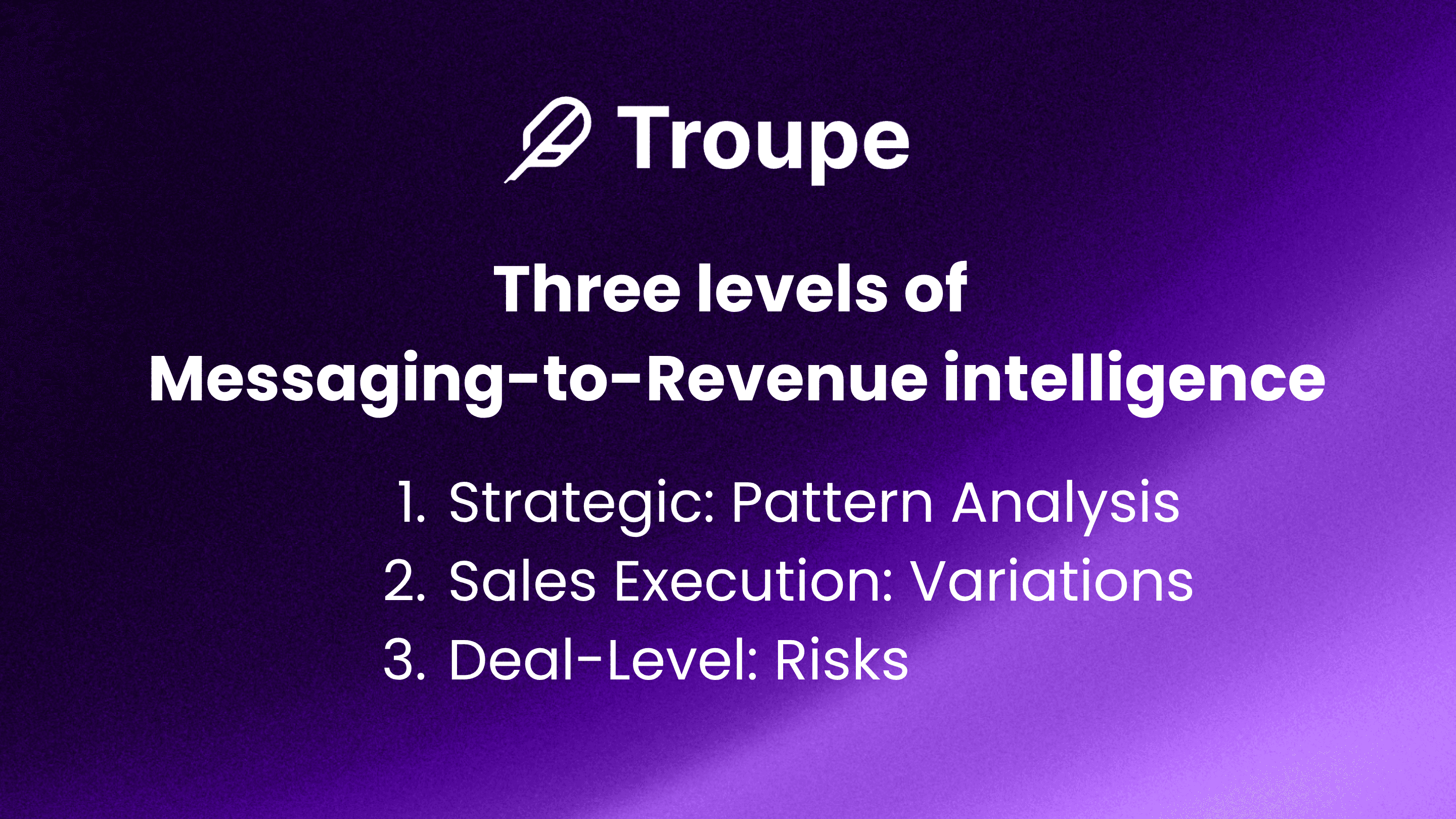
What it shows: Three levels of messaging-to-revenue intelligence
While Troupe's solution gives you a picture of your messaging's level of adoption, alignment, and performance, this demo focuses on the latter: revenue performance. The demo moves from the big picture down to individual opportunities. Each level answers a different question:
- Strategic: pattern analysis. Which messages are tied to more revenue, and which are holding it back? (
- Sales execution: variations. How are reps putting their own spin on the messaging guide, and is that helping or hurting win rates?
- Deal level: risks. Which open deals are missing the messages that win, and how much pipeline is at stake?
Level 1: Find the messages that move revenue
Troupe's AI reviews your sales interactions and automatically surfaces patterns in how your messaging performs. The Insights view sorts findings into vulnerabilities, gaps, opportunities, strengths, and momentum shifts, each with its likely revenue impact. You see an executive summary up top and can drill into whichever finding matters most.
The demo shows how certain findings can standout. In this example: Reps describe the product in several ways, and one version wins just 19% of the time. However, a sharper version wins at a rate that's more than double. This fictional demo reflects real-world cases Troupe sees with our customers.
Troupe doesn't stop at the observation. It shows the evidence, recommends specific actions ("coach toward the stronger message variation, refactor the weaker message"), and sizes the stakes: about $2.26 million of open pipeline across 13 deals currently relies on the weaker message. Applying the observed win-rate difference puts roughly $700,000 in more revenue in play.
Level 2: Settle the message testing and variation debate with meaningful evidence
No sales team delivers the messaging guide word for word. Reps adapt it, create their talk tracks they find comfortable, and some of those adaptations work better than the original. Others cost you deals, even though that's certainly not the intention.
The Message Variations view groups the recurring ways reps put their own spin on each topic in your guide, then shows how each variation performs against the official version. You can see who is using it, in which deals, with which personas, and how much pipeline is riding on it.
In this demo, we zoom in on a "lowest total cost of ownership" message example, where Troupe found two field variations used by the field. One shows a lower win rate than average, with the deals that back that up, and the other variant shows a higher win rate, again with the data behind it.
That gives product marketing hard evidence for which version to codify in a refreshed guide, and gives sales enablement and sales team managers data to back up their coaching. Troupe also flags where a sample is still small, so you know when to test further before rolling a change out broadly.
Level 3: Close the messaging gaps in open deals
Insights are only valuable if they change what happens in live deals. Troupe's Pipeline view shows which messages convert at each stage, from prospecting through proposal, then flags the deals that need attention.
Troupe sorts those deals into clear categories: at risk, unaddressed objections, missing messaging, and stalled. In the demo, the sample "Zero-Downtime Updates" message has a clear win rate lift, but 34 open deals worth about $6 million haven't heard it yet.
Click into the group and you get the list of affected deals, with stage, owner, and value. Open any deal to see which other high-performing messages are missing and what has already been covered; figure out which deals are relevant to apply this message. Reps can copy the recommended messaging straight into their next conversation.
For revenue leaders, this is a practical pipeline review tool: a short, prioritized list of deals where the right message could shift the odds.
A note on the numbers
Troupe is careful about what our figures mean. The revenue estimates are directional: they apply observed win-rate differences to your current pipeline. They show correlation, not guaranteed lift, and Troupe flags when a sample is too small to project. That honesty is what makes the insights safe to act on and easy to defend in front of your CRO and CFO.
These also aren't one-off messaging tests. Troupe is looking at data patterns in aggregate and over time, as well as providing for the drill-downs to deal and even interaction level. But unlike other quick message testing or research tools, Troupe is giving you living, real-world, real-context messaging intelligence that's always on.
Ready to win more with your messaging?
The demo covers just three of Troupe's messaging-to-revenue features. To see what Troupe finds in your own sales conversations, contact us for a deeper demo, a trial, or pricing.