

What B2B Messaging Intelligence Reveals About Your GTM Story
Review of real customer findings by Troupe: data about the messages that lift sales conversions and wins, which drag them down, and what marketing and revenue teams can do about it.
When B2B companies start tracking their go-to-market messaging against real pipeline outcomes, patterns appear. They can see what needs to be scaled up and what needs to be fixed.
Examples from customers using Troupe’s AI for B2B Messaging Intelligence demonstrate such patterns such as:
- Some of the highest-performing messages are used in only a small share of deal cycles.
- Some of the most-used sales talk tracks actually lower win rates.
- Variations that sales reps use for a key message can swing results in opposite directions.
- Messages that win new business often don't work for existing customer renewals and expansion.
None of that is intentional. Nobody is deliberately using lower-performing messages and talking points. It happens because until GTM teams start linking their messaging plan to their actual delivery and outcomes, they remain in the dark, with no way of knowing the pieces of their story that are working, at what stage, to what personas, and in what deal types.
As user Brianna Kelly, senior product marketing manager at Fleetio, told us:
“Troupe gave us visibility into our messaging performance that we didn't have before. We could clearly see which of our recently launched messages were contributing to stronger conversion and win rates in new business, while also uncovering opportunities to improve how our messaging was landing in renewal and expansion conversations.”
That's the transparency and awareness B2B Messaging Intelligence brings. In this article, we share real yet anonymized findings from Troupe customers so you get a tangible picture of the type of data that is revealed. Once you have such clear and objective evidence, you can act to improve the ROI of your GTM storytelling and all the campaigns and investments that activate it.
What is B2B Messaging Intelligence?
B2B Messaging Intelligence is the practice of measuring how a company's go-to-market story is adopted across touchpoints and content, and then connecting that usage to outcomes, such as sales pipeline conversions, deal velocity, friction points, and win rate. It connects three points: what you want to say, what is actually said, and what happens as a result.
Troupe’s advanced AI was built exactly for this specialized job, and it’s something you can’t get from a general LLM with chatbot prompts or from using tools like Gong.
Messaging intelligence and the tracking it does differs from conversation intelligence, which focuses on what happens in sales calls. Messaging intelligence instead aggregates the data from every call, email, and content asset against the messaging guide itself, across the full funnel, and finds the patterns that are statistically meaningful. Think of it as operating at a higher altitude than conversation intelligence.
B2B Messaging Intelligence: Customer Outcomes at a Glance
The findings below come from Troupe customers, all B2B companies. Company names and specific message content are anonymized. The numbers are real and unchanged.
For each customer, Troupe used the company's messaging guide as the benchmark. Troupe's AI then analyzed sales call transcripts, content assets, and CRM deal data. That analysis takes a historical capture plus continuously ingests the newest interactions and content in real time. Win rates are compared against each customer's own baseline, which is why baselines differ from one finding to the next.
A Common Pattern: Winning Messages Aren’t Used in Deals
Across multiple Troupe customers, we find that planned messages that have the highest win rates appear in only a small share of deals. The problem isn't the message, it's adoption. But to reiterate: this is not intentional, these companies simply lacked the visibility and evidence in order to steer their teams and execute campaigns and practices that apply what’s more effective.
Example: A new AI message won at more than twice the baseline rate
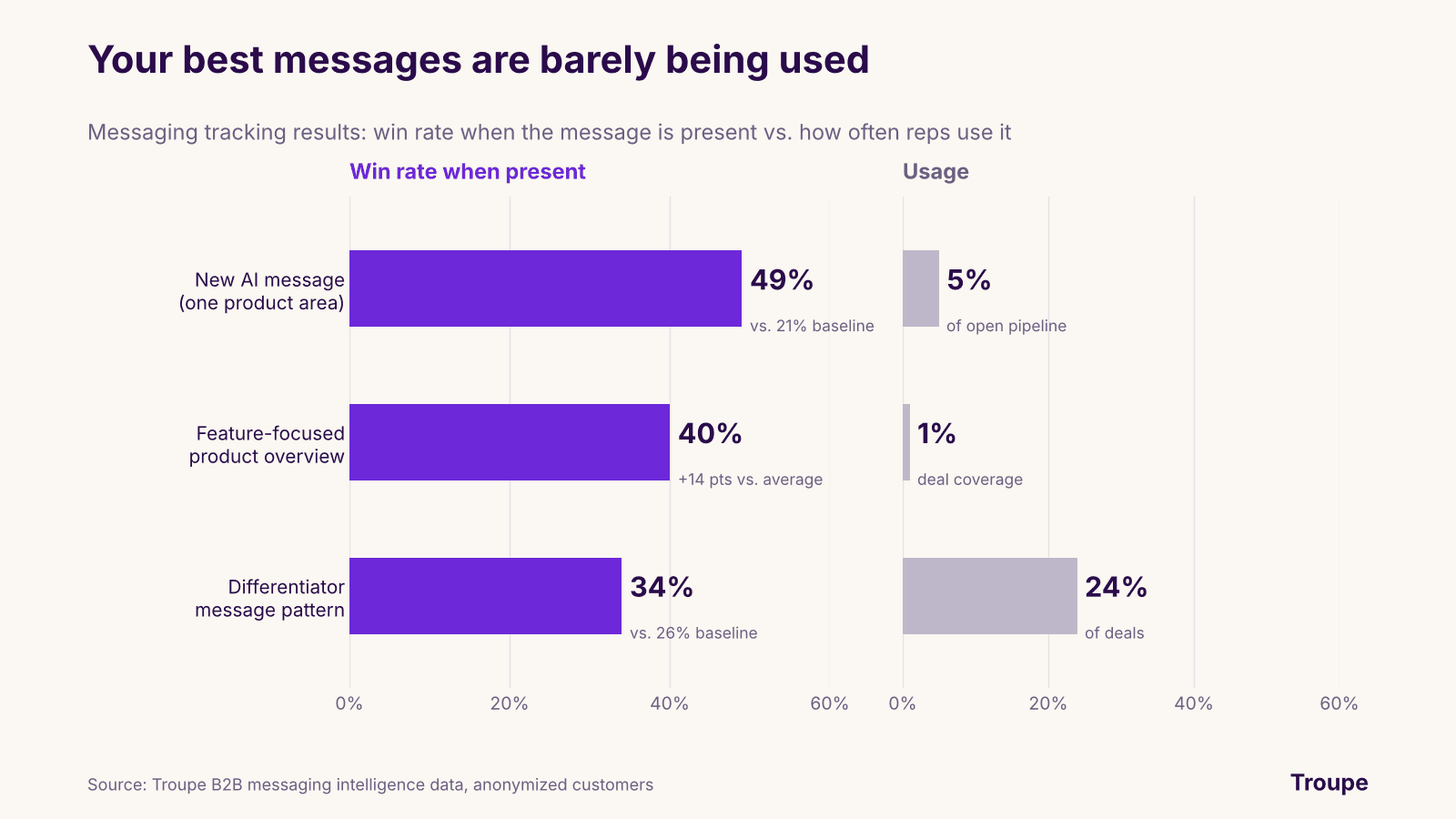
Let’s add some color to one of the example data findings. One B2B SaaS customer with 100+ sellers launched new AI capabilities. One of its new AI messages for a major product area matched a statistically significant 49% new business win rate vs. a 21% baseline, based on 51 closed deals.
But the message appeared in only 5% of open pipeline, influencing far less than it could. And when it was used, alignment to the planned message could also be improved; it scored in aggregate 64/100 on that consistency metric (Troupe recommends a 70 or higher target alignment score).
Another Common Pattern: Sales-Driven Messages Have Different Outcomes
Troupe’s B2B Messaging Intelligence has surfaced cases where popular talk tracks, variations of messages, and off-message content were holding deals back, even though teams assumed they were working. Again, it’s not deliberate; everyone’s just operating on gut-feel and “vibes” versus data in the absence of a solution.
Example: High-usage talk tracks dropped win rates
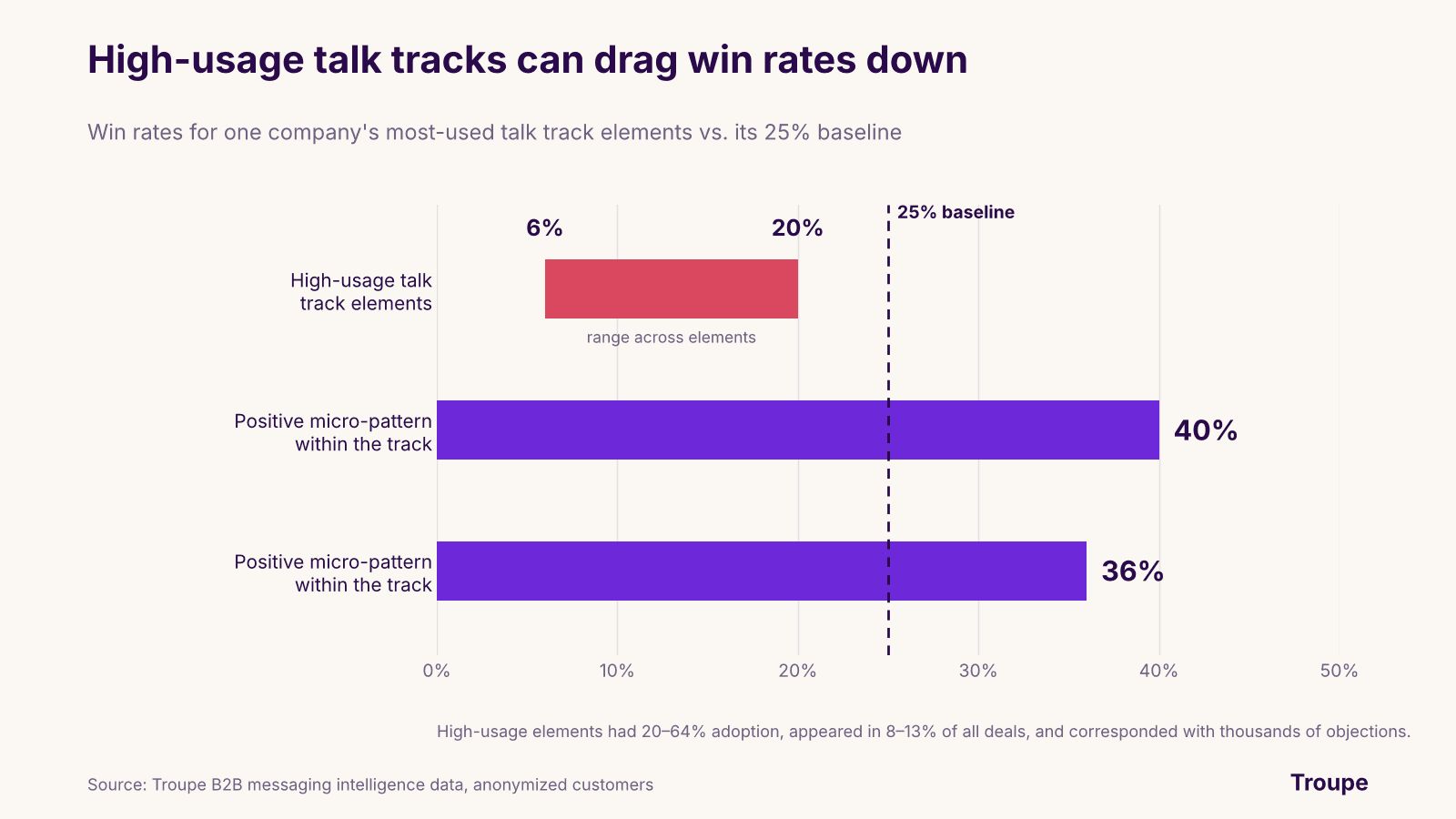
At one company, sales gravitated toward one particular portion of the messaging guide and gave it high use in their calls and interactions. Unfortunately, both sales and marketing learned with Troupe that that set of messages correlated with lower win rates of 6%–20% vs. their 25% baseline.
Even further, Troupe found those talk tracks corresponded with thousands of objections across deals in the past year, especially around pricing, integration, feature gaps, and use-case fit.
That said, Troupe found some positive micro-patterns inside the same talk tracks. One correlated with a 40% win rate and another with a 36% win rate, but they were exceptions rather than the standard.
Example: Two variants of one message had opposite results
One customer used Troupe to identify and compare message variations that the field was creating, as well as to find any purely “rogue” messages.
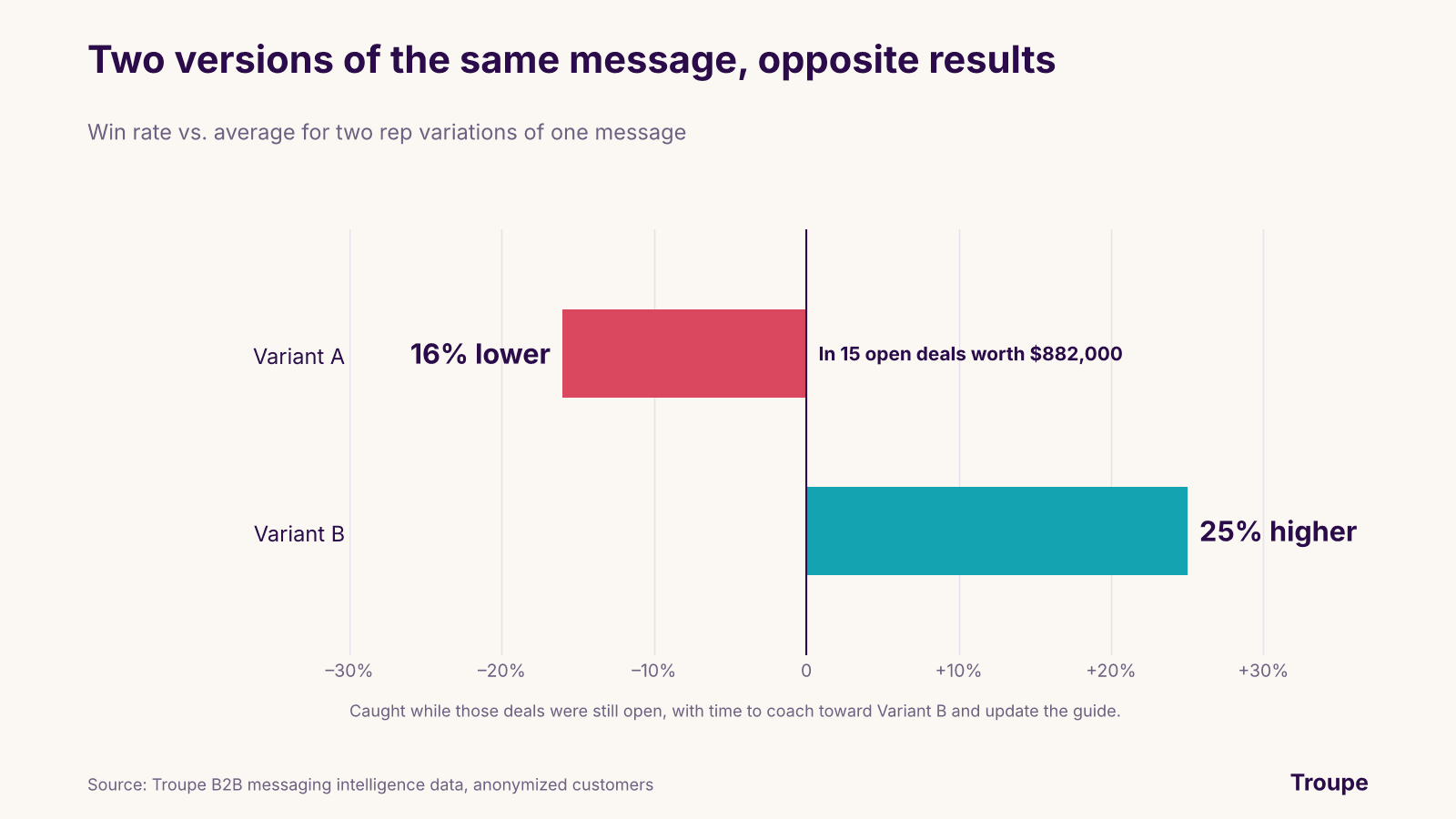
What was found is that for a relatively newer yet top-pier message, one variant used by 8 sales team members dropped win rate by 16% compared to the average. This lower-performing version appeared in 15 open deals valued at a combined $882,000, putting that revenue number at higher risk of a lower close rate. Another variant used by 6 sales team members lifted win rate by 25%.
This is actionable, because the signal surfaced while there was still time to coach reps toward the winning variant on open deals, as well as to coach the broader sales organization and have product marketing update the messaging guide accordingly. This type of insight is also helpful for intentional message testing and experimentation.
Third Pattern: Messages Often Land Differently for New Business vs. Existing Customers
Most messaging guides are written for net-new buyers, which becomes clear for many companies once they start tracking the performance of messages based on deal types.
In one of the examples, a B2B company was able to use Troupe to compare message performance by deal type, using statistically significant sample sizes. 30 messages from their guide lifted new business win rates by 2X or higher when present vs. missing. Only 2 messages from the guide lifted customer renewals or expansions, and at a lower lift.
At another company, customer expansion win rates dropped considerably when reps applied moderately well-adopted core messages from the messaging guide.
When do Customers use Messaging Intelligence?
Key drivers and inflection points for either Marketing or Revenue teams bringing in Troupe have included:
- A new product or major feature launch. New messaging goes to the field, and both teams need to know whether reps use it and whether it wins.
- A messaging refresh. The refreshed guide needs evidence that it outperforms what it replaced.
- An acquisition. Two stories must merge into one, and sales needs to know which parts of each still win deals.
- A new head of marketing or product marketing. A new leader needs a fast, data-backed baseline of what's working before making changes.
- Planning and kickoffs. Rallying the team around initiatives and a shared vision is best when you can back that up with real evidence.
See which of your messages win deals. Book a demo to find out what your deal data says about your story.
Frequently asked questions about B2B messaging intelligence
What is the difference between messaging intelligence and conversation intelligence?
In B2B, conversation intelligence tools focus on sales calls and later-stage deal activity. Messaging intelligence compares every call, email and content asset against your messaging guide, across the full funnel, and ties each message to pipeline outcomes. The two work together: Troupe ingests transcripts from call recorders such as Gong and Chorus and then provides strategic-level insights about how well the story is working overall and where to fix it.
What is the ROI on B2B messaging intelligence?
It can be substantial. Improving new business win rate even by 10 percentage points, through the use of higher-performing messages, can mean hundreds of thousands if not millions of dollars in additional revenue. That doesn’t take into account increasing the volume of qualified deals moving into the pipeline and improved customer retention and upsells. With a tool like Troupe starting at an average of $35,000 per year for many customers, the ROI is significant.
How do you measure whether a sales message is working?
Compare the win rate of deals where the message is present against deals where it's absent, or against your baseline win rate. Then check adoption (how often it's used) and alignment (how closely it matches the intended message). A message with high win rates but low adoption, like the new AI message above, is a coaching opportunity. Tools like Troupe are designed to do this automatically.
What data does B2B messaging intelligence require?
Three inputs: your messaging guide as the benchmark; your call transcripts, emails, and content assets; and CRM pipeline data from a system such as Salesforce or HubSpot to measure outcomes.
Who uses B2B messaging intelligence?
Product marketing teams typically use it day to day to manage the messaging guide. CMOs use it to show the revenue impact of the go-to-market story. Sales leaders, enablement teams and revenue operations use it to coach on winning messages and resolve messaging debates with data.